
Introduction
Drilling a borehole is only the first step in securing groundwater. The real question begins afterward: How much water can the borehole sustainably produce?
In Zimbabwe, where groundwater demand continues to increase across residential, agricultural, commercial, and institutional sectors, borehole capacity testing is not optional. It is a technical necessity.
Without proper yield and recovery testing, property owners risk installing oversized pumps, over-extracting groundwater, or damaging the borehole system prematurely.
At Ragnarock Drilling, borehole capacity testing is approached as a structured engineering process designed to protect both the client’s investment and the aquifer itself.
What Is Borehole Capacity Testing?
Borehole capacity testing, also known as pump testing or yield testing, is a technical evaluation of a borehole’s:
- Sustainable discharge rate (litres per hour)
- Recovery rate after pumping
- Drawdown levels
- Aquifer recharge behaviour
The objective is to determine how much water can be safely extracted without depleting the groundwater source or damaging the borehole.
Why Capacity Testing Is Critical in Zimbabwe
Increasing Water Demand
Across Zimbabwe, boreholes support:
- Residential water supply
- Irrigation systems
- Schools and institutions
- Commercial and industrial operations
Without proper testing, many boreholes are pushed beyond their safe yield limits.
Preventing Over-Pumping
One of the most common mistakes in borehole installations is selecting a pump that extracts water faster than the aquifer can recharge.
Over-pumping can lead to:
- Declining water levels
- Dry boreholes during peak usage
- Pump damage due to air intake
- Reduced borehole lifespan
Capacity testing prevents these outcomes by aligning pump selection with sustainable yield.
The Borehole Capacity Testing Process
Step 1: Controlled Pumping
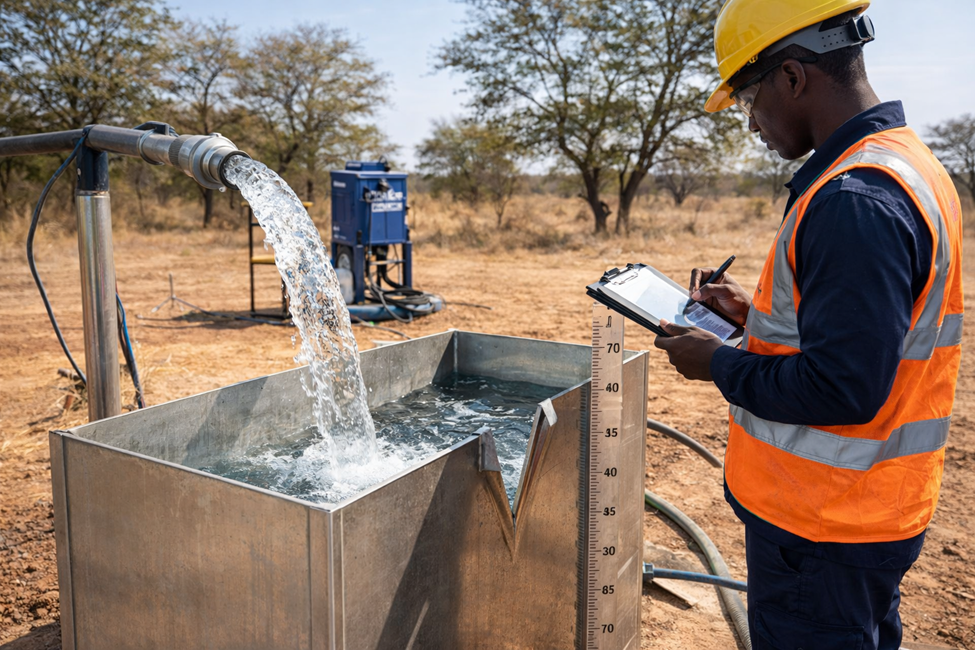
Water is pumped from the borehole at a measured rate for a defined period. Flow rate is monitored using calibrated measuring equipment.
This establishes the borehole’s discharge capacity under sustained extraction.
Step 2: Drawdown Measurement
During pumping, technicians measure the water level drop (drawdown). Excessive drawdown may indicate limited recharge capacity.
Accurate drawdown data is essential for long-term planning.
Step 3: Recovery Monitoring
After pumping stops, the borehole’s water level is observed as it recovers. The speed and stability of recovery reveal the aquifer’s recharge capability.
Recovery rate determines whether the borehole can sustain continuous or intermittent use.
Matching Pump Size to Borehole Yield
Installing the correct pump size is directly dependent on capacity testing results.
An oversized pump:
- Extracts water too quickly
- Causes excessive drawdown
- Increases operational costs
- Risks mechanical failure
An undersized pump:
- Limits water availability unnecessarily
- Reduces efficiency
Proper testing ensures optimal pump selection based on real data.
Sustainability and Aquifer Protection
Groundwater is a shared resource. Sustainable extraction protects not only the individual borehole but also surrounding water users.
Capacity testing supports:
- Responsible groundwater management
- Long-term water security
- Reduced environmental impact
- Protection of community water sources
In areas where groundwater may be limited, disciplined testing is particularly important.
Common Myths About Borehole Yield
Myth 1: If water is flowing, the borehole is fine.
Initial flow does not indicate sustainable yield. Without testing, long-term performance cannot be guaranteed.
Myth 2: Bigger pumps provide better results.
Pump size must match recharge rate. More powerful pumps often reduce reliability rather than improve it.
Myth 3: Capacity testing is optional.
Skipping capacity testing increases long-term financial risk and may shorten borehole lifespan.
When Should Capacity Testing Be Conducted?
Capacity testing should be performed:
- Immediately after drilling
- Before pump installation
- When water yield declines
- Before expanding water usage (e.g., adding irrigation)
It is especially important in agricultural and commercial applications where demand is high.
The Financial Perspective
Boreholes represent significant capital investment. Capacity testing protects that investment by:
- Preventing premature equipment failure
- Reducing maintenance costs
- Extending borehole lifespan
- Avoiding costly re-drilling
In Zimbabwe’s economic environment, protecting infrastructure investments is essential.
Professional Oversight Matters
Accurate capacity testing requires:
- Calibrated measurement equipment
- Experienced technical personnel
- Structured monitoring procedures
- Proper documentation
Ragnarock Drilling conducts capacity testing with disciplined engineering standards to ensure that clients receive reliable data for decision-making.
Conclusion
Drilling a borehole without conducting capacity testing is comparable to building infrastructure without load testing. It introduces unnecessary risk.
Sustainable groundwater extraction begins with understanding the borehole’s true capacity.
For homeowners, farmers, developers, and institutions in Zimbabwe, borehole capacity testing provides clarity, protects investment, and supports long-term water security.
Get in touch
If you have recently drilled a borehole or are planning pump installation, consult Ragnarock Drilling for professional capacity testing services across Zimbabwe.
Reliable water begins with accurate measurement.